Stepping from military service into a high-demand civilian career is easier when your education benefits work as hard as you do. Heating, ventilation, and air conditioning is a resilient trade with steady demand, strong starting wages, and clear advancement paths. For many transitioning service members and veterans, HVAC training offers the ideal blend of mission-driven problem solving and hands-on technical work. With the right VA-approved program, you can convert hard-earned benefits into marketable skills—fast—while building a foundation for long-term growth in residential, light commercial, or specialized refrigeration and controls.
Whether you’re aiming to become an installer, maintenance technician, troubleshooter, or move into design and commissioning, the right curriculum emphasizes real-world skills: safe electrical practices, system design, airflow and duct diagnostics, heat pumps, refrigerant charging, and furnace fundamentals. Below, you’ll find a practical roadmap to choosing and using a VA-approved program, what comprehensive training should cover, and how to shape your path from the classroom to the job site with confidence.
What “VA-approved” really means for HVAC training—and how to use your benefits
When a program is VA-approved, it means the U.S. Department of Veterans Affairs—often working with your state approving agency—has reviewed the curriculum and institution to ensure it meets standards for veterans’ education benefits. This approval is the key that allows you to use the Post-9/11 GI Bill, the Montgomery GI Bill, or programs like Veteran Readiness and Employment (VR&E) to cover tuition and, in many cases, receive a housing allowance and a book stipend while you train. Some programs are short-term technical courses, others are longer diploma tracks; many also connect to apprenticeships or on-the-job training pathways that extend your benefits as you earn and learn.
Getting started is straightforward. First, identify the HVAC program that aligns with your goals—residential service, commercial systems, or a well-rounded generalist route. Next, verify that the school and specific course are approved. You can use the VA’s tools to search approved programs, contact the school’s School Certifying Official (SCO), or check with your state approving agency. After confirming approval, apply for your benefits—commonly via VA Form 22-1990 if you’re new to using the GI Bill—and request your Certificate of Eligibility (COE). The SCO then certifies your enrollment so payments can be processed.
What expenses can your benefits cover? Depending on your eligibility tier and the program structure, VA education benefits can pay for all or part of your tuition, a monthly housing allowance (for in-person training), and a stipend for books and supplies. Some programs also embed key industry credentials—like EPA 608 certification testing—so you leave with the qualifications employers require for handling refrigerants. If you’re using VR&E, your counselor may authorize additional supports related to training and placement, especially if you’re custom-building a pathway back into the workforce.
Timelines vary, but many students complete core HVAC fundamentals in a matter of months, then move into entry-level roles while continuing advanced modules part-time. This “stackable” approach lets you start earning quickly, gain jobsite experience, and deepen skills in areas like system design, commissioning, air balancing, and advanced troubleshooting—often still within the umbrella of VA-supported learning. For family members, the Fry Scholarship and Survivors’ and Dependents’ Educational Assistance (DEA) can be options when eligibility applies; always confirm with the VA or your SCO.
One final tip: ask schools how they support veterans. Do they offer flexible schedules for drill or medical appointments? Are labs structured around hands-on practice from day one? Do instructors emphasize the practical realities of the field—customer communication, accurate documentation, and safe, quality installation? These can be the difference between a certificate and a career.
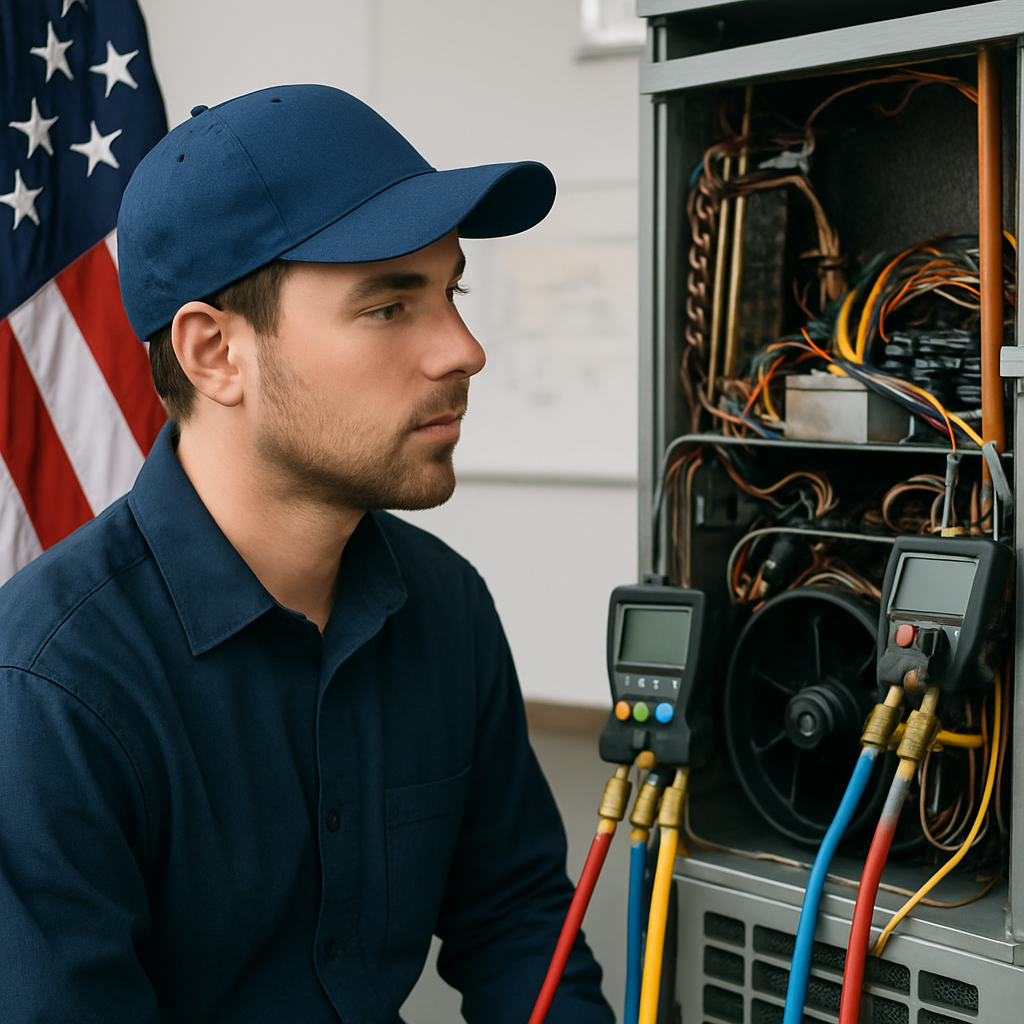
What a veteran-ready HVAC curriculum should cover: hands-on skills that transfer to the field
Quality HVAC education is more than theory; it’s a progression of hands-on HVAC training that makes you competent and confident on day one. Expect to start with safety and electrical fundamentals: tool identification, lockout/tagout, reading wiring diagrams, meter usage, interpreting nameplate data, and tracing low- and high-voltage circuits. From there, you’ll build core refrigeration knowledge—heat transfer principles, the pressure-temperature relationship, superheat and subcooling, and the correct procedures for recovery, evacuation, leak detection, and refrigerant charging. The program should include structured preparation for EPA 608 certification, since that credential is mandatory for most HVAC roles.
Airflow is the heartbeat of system performance. A veteran-ready program trains you to measure external static pressure, interpret fan tables, calculate CFM, and diagnose restrictive ductwork, dirty filters, or undersized returns. You should practice duct renovation strategies, learn best practices for sealing and insulating, and connect field measurements to design principles using Manual J (load calculations), Manual S (equipment selection), and Manual D (duct design). These skills directly impact comfort, efficiency, and system longevity—key outcomes valued by homeowners and building managers alike.
Modern comfort systems rely heavily on controls. Expect modules on thermostats, communicating systems, zoning panels, economizers, and integration with smart home platforms. Heat pump training deserves special emphasis: understanding defrost strategies, cold-climate performance, auxiliary heat staging, and how to commission variable-speed systems so they deliver the efficiency they promise. On the combustion side, furnace fundamentals should include ignition sequences, combustion analysis, venting, and proper gas pressure adjustment.
Equally important are the soft skills and jobsite habits that translate your technical knowledge into customer satisfaction and reduced callbacks: clear communication, accurate work orders, and a disciplined approach to quality installation. Many high-impact programs also expose students to light commercial gear, walk-in coolers, or VRF/VRV basics, giving you a broader view of the trade. If you’re exploring programs, look for curricula that mirror real job scenarios—troubleshooting a no-cool call, commissioning a multi-zone system, or balancing airflow after a duct retrofit. Programs like VA approved HVAC courses emphasize these real-world exercises so you can move from lab bench to ladder with confidence.
Career pathways, timelines, and real-world scenarios for transitioning service members
With the right plan, you can transition quickly and keep advancing. A common timeline looks like this: 10–20 weeks to complete core fundamentals and EPA 608, 4–8 additional weeks to deepen diagnostic and design skills, then immediate entry into the field as an installer’s helper or maintenance tech. From there, the on-the-job learning accelerates. Many employers sponsor advanced training while you work, and if you pursue an apprenticeship or on-the-job training (OJT) program, your VA benefits may continue to offset income gaps as you climb the wage ladder.
Entry points vary. Residential install offers fast hands-on exposure: setting equipment, brazing line sets, pulling vacuum, verifying charge, and documenting start-up data. Service roles involve more diagnostics—electrical troubleshooting, refrigerant circuit analysis, and resolving airflow issues. With experience, you can branch into light commercial, building controls, or specialization in heat pumps, hydronics, or refrigeration. Technicians with strong airflow and system design skills often move into sales engineering, commissioning, or quality assurance roles where they set standards that reduce warranty claims and elevate customer satisfaction.
Consider “Alex,” an Army veteran who used the Post-9/11 GI Bill to complete a focused HVAC fundamentals program. After earning EPA 608 and a job readiness credential, Alex joined a contractor serving mixed-climate neighborhoods. Within months, Alex led installations, applying air balancing methods and verifying superheat/subcooling targets to cut callbacks. The next step was advanced heat pump commissioning, followed by training in load calculations—skills that opened doors to higher-paying diagnostic roles.
Or “Sofia,” a Navy veteran working with VR&E to pivot into energy-focused HVAC. A program highlighting zoning, variable-speed equipment, and cold-climate performance prepared her for a utility-partnered contractor specializing in electrification. Sofia now conducts in-home assessments, matches equipment to Manual J results, and verifies duct renovations—demonstrating how strong fundamentals plus targeted upskilling can position you at the forefront of market trends.
Geography matters, too. Regions with large military communities—think Tidewater, San Antonio, Colorado Springs, Jacksonville, or Puget Sound—often see year-round demand and strong employer networks. In colder climates, deep knowledge of defrost strategies and auxiliary heat management make you invaluable; in hot, humid zones, latent load control and ventilation strategies take center stage. Wherever you land, the essentials remain: safety, quality installation, accurate diagnostics, and clear communication. When your training is anchored in these principles, your transition from service to skilled trade is not just smooth—it’s sustainable, with continuous opportunities to grow your earnings and impact.
As you evaluate programs, prioritize those that respect your time, recognize your discipline, and deliver a structured path from fundamentals to advanced practice. Look for curricula that blend classroom clarity with robust lab time, emphasize commissioning and documentation, and build toward industry-recognized milestones. With your VA benefits and a mission-ready training plan, you can move decisively into a stable, respected career—one system startup, one satisfied customer, and one quality installation at a time.

Karachi-born, Doha-based climate-policy nerd who writes about desalination tech, Arabic calligraphy fonts, and the sociology of esports fandoms. She kickboxes at dawn, volunteers for beach cleanups, and brews cardamom cold brew for the office.